
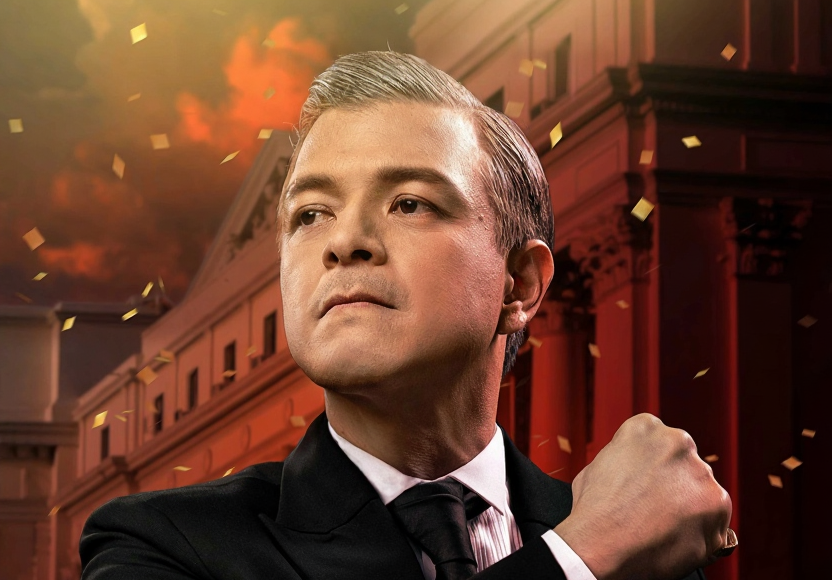
It started with Heneral Luna, continued with Goyo: Ang Batang Heneral, and now concludes with Quezon. In Bayaniverse’s final chapter, the life of Manuel L. Quezon takes center stage. The film explores how Quezon’s intricate political career helped shape the Philippines’ path toward independence—and how his actions challenge the very notion of what it means to be a bayani.
Here is SEA Wave’s High Five movie review of Quezon.
The Cinematic Value

Photo courtesy of Pong Ignacio and Trixie Vertera
Quezon ushers us into 20th-century Philippines, showcasing Filipinos’ relentless pursuit of independence. It was a time of political tension and national awakening — and the film’s production captures that flawlessly.
A hallmark of the Bayaniverse films has always been their impeccable production design, and Quezon once again delivers on that promise. The authentic set pieces and carefully chosen locations transport viewers straight into the era. The film nails the technical aspects with strong cinematography, precise editing, and a well-executed score, creating an immersive experience that feels both cinematic and historically resonant.
Quezon has the makings of a monumental piece of Philippine cinema. The way this film was crafted makes it feel like you’re watching history unfold before your very eyes.
The Intersection of History and Fiction

Manuel L. Quezon and Jericho Rosales as Manuel L. Quezon
Quezon is a historical film — but not entirely biographical. It chronicles the life of Manuel L. Quezon, from his early days as a young officer during the Philippine–American War to his rise as the first president of the Commonwealth. The film also delves into Quezon’s adversaries and the controversies that shaped his political career. While it presents several historically grounded events, certain moments are fictionalized for dramatic and thematic effect.
By balancing fact with fiction, Quezon tells a story that feels compelling while never losing sight of its historical roots. As director Jerrold Tarog noted in a forum in July 2025, “This is important: film is not a historical document. This (Bayaniverse) trilogy is a dramatization of concepts and historical accounts in books, mixed with fictional elements to better explore the idea of the Bayani.”
The fictional and real characters in Quezon intertwine seamlessly, creating a narrative that feels rich, dynamic, and alive. While the portrayal of the real characters is difficult to measure against their real-life counterparts, each actor was able to deliver memorable performances and give life to names we merely read in history books.
Jericho Rosales stands out as the titular Quezon, embodying the role with precision, charisma, and quiet intensity. His performance, along with the rest of the ensemble, makes the characters feel tangible — exposing their flaws and complexities. In doing so, the film doesn’t just recreate history — it humanizes it.
The Complexity of Being a Hero
Manuel L. Quezon was many things — a soldier, a lawyer, a politician, a father. But what many don’t know is that he was also regarded as a chameleon. In the film, he is portrayed as cunning, manipulative, and strategic — a man unafraid to play dirty to get what he wants. Yet his fight wasn’t always for the greater good, but often for self-gain, which raises the question: Was it ever about independence, or was it about power?
The film exposes the unpleasant sides of Quezon — the parts of him history tends to gloss over. As the truth about his past and questionable compromises unfolds, we begin to wonder whether Quezon was truly a hero or simply a man who mastered the game of politics.
By creating these doubts, Quezon fulfills the Bayaniverse’s purpose — to dissect heroism itself, and question why certain figures are regarded as heroes. While these “heroes” and characters are portrayed in specific ways, Quezon emphasizes that the line between good and bad is thin — far more nuanced than simple labels. A hero is just as layered as their story, and how it is framed is crucial, as it determines the audience’s perception.
The Politics of Storytelling

The stellar cast of “Quezon” led by Jericho Rosales, Mon Confiado, and Iain Glen | Photo courtesy of TBA Studios
The truth is a powerful thing — but it can also be twisted, manipulated, and weaponized. In Quezon, the film employs a film-within-a-film device as a campaign tool. Quezon, the character, uses cinema itself to persuade the masses through a glorified portrayal of his life and his supposed contributions to Philippine independence. By doing so, he sells his own version of the truth — one carefully crafted for personal and political gain. Yet as the story unfolds, the film exposes the other side of that truth: the uncomfortable realities and moral compromises behind the image he built.
Through this, Quezon reveals the power of storytelling — how easily it can shape, distort, and redefine reality. It compels us to question the authenticity of the stories we regard as history. It will dare you not to blindly believe the truth, but to question it and to challenge you not to accept things as they are presented. By showing how effortlessly the truth can be rewritten, Quezon reminds us that history itself is a political act — one shaped not by those who live it, but by those who tell it — a message that feels all the more urgent today.
The Bayaniverse Legacy

Official Posters of The Bayaniverse Trilogy
Quezon tackles one of the most lethal wars the Philippines has ever faced — one without bloodshed or gunfire, but equally as deadly: politics. Unfortunately, that war is far from over, even decades later. The film portrays all-too-familiar scenes: politicians turning on one another, alliances shifting, those in power passing blame, and corruption thriving in both its simplest and grandest forms.
Upon reflection, the most heartbreaking thing about Quezon isn’t what it shows, but what it mirrors — our present reality. As director Jerrold Tarog once said, “What’s happening today has already happened before.” The film raises uncomfortable questions about the price of progress and the cyclical nature of power.
Screenwriter Rody Vera summarizes it best: “The film offers no hope for how we could possibly change a political system that has been entrenched for roughly a hundred years to date.”
And yet, while Quezon reminds us that history often repeats itself, there remains a light at the end of the tunnel — because films like Heneral Luna, Goyo: Ang Batang Heneral, and Quezon spark conversations and challenge complacency. Though this may mark the end (for now) of the Bayaniverse, its spirit endures — echoing in every viewer reminded that heroism is not found in perfection, but in the courage to confront the truth.
In the end, Quezon goes beyond being a historical film. It captures not just our history, but our story as Filipinos — a timely cinematic piece that both enlightens and endures.
SEA Wave rates it 4 out of 5 waves.