
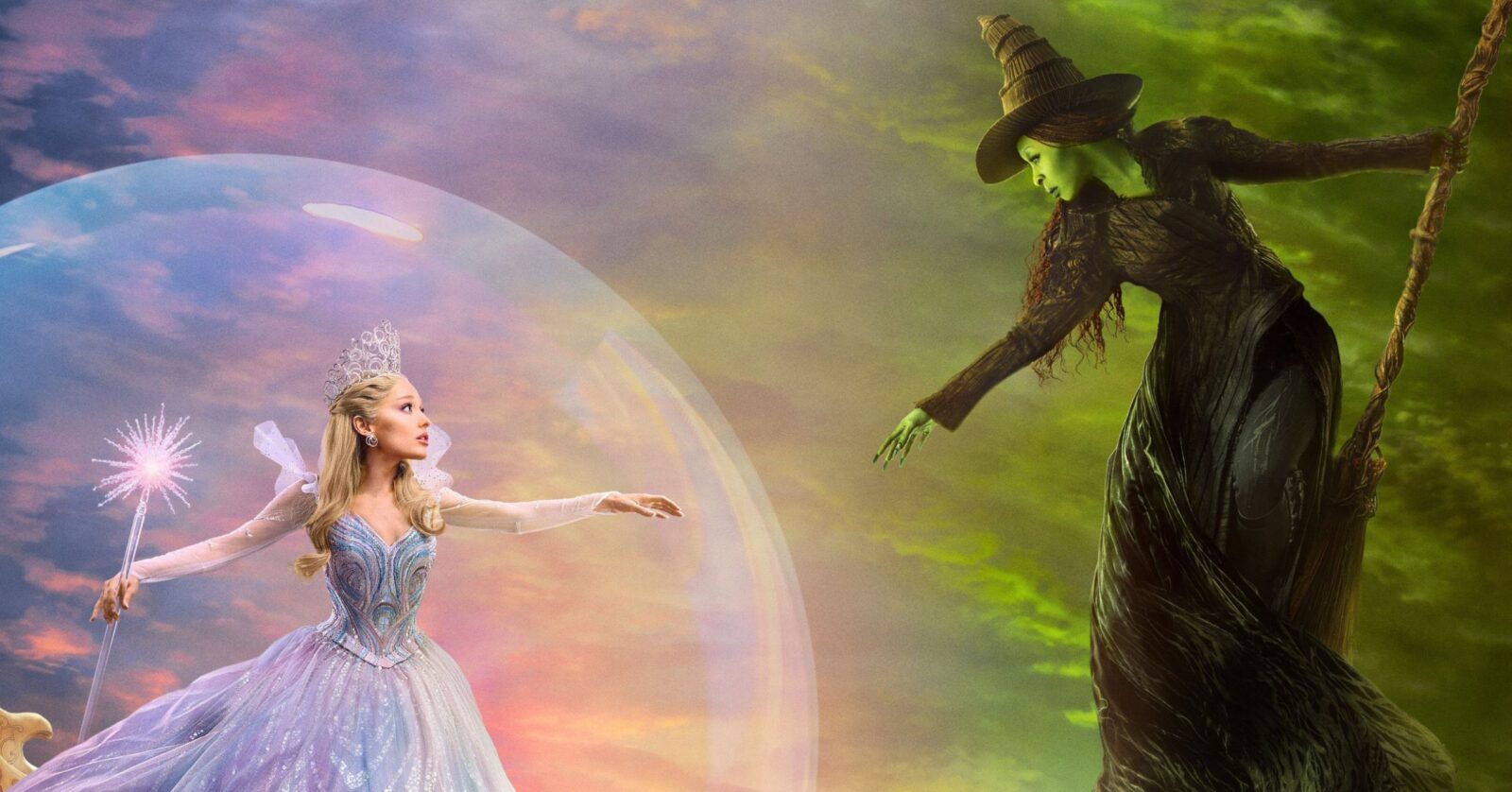
The yellow brick road leads to this—the final chapter in the untold story of the Witches of Oz: Wicked: For Good.
One year after the events of Wicked, Glinda the Good now reigns over Emerald City, while Elphaba remains in exile, branded forever as the Wicked Witch of the West. With the stakes higher than ever, the film takes viewers on an emotional ride as Elphaba, Glinda, and all of Oz face their greatest battles to reach an epic conclusion—one that will leave you forever changed.
Here is SEA Wave’s High Five review of Wicked: For Good.
A Shift in the Emerald Glow
We’ll cut to the chase—Wicked: For Good doesn’t capture the magic of the first film, due in large part to the shift in the story’s tone. While Wicked focused on Elphaba and Glinda’s origins and how their unlikely friendship was formed, Wicked: For Good focuses on the aftermath of Elphaba discovering her power and defying the Wizard.
The film’s atmosphere is more politically charged, built around propaganda that paints Elphaba as a threat because of her fight for Animal rights and her mission to expose the Wizard’s lies. The story has lost its innocence, and the music reflects that shift. Instead of playful songs like “Popular” or “Dancing Through Life,” we get numbers like Wonderful—upbeat on the surface yet masking corruption, mirroring how the Wizard manipulates Elphaba into surrendering. This makes for a palpable departure in tone that makes the sequel feel much more grounded, yet less bombastic.
Though the enchantment has diminished, the visuals and production remain nothing short of spectacular, and the magic simply takes on a new form—one unleashed through Elphaba’s power, powerful enough to reshape Oz and everyone within it.
The Good, the Wicked, and Everything Between

Elphaba confronting Glinda | Photo from Universal Pictures
With Elphaba feared as the Wicked Witch of the West, Glinda rises as the beloved Glinda the Good — a shining emblem of hope and stability for the people of Oz. But the image is a façade. She is a symbol manufactured by those in power, a pawn used to reinforce the lie that Elphaba is dangerous.
The two are positioned as opposites—good versus wicked—when in reality, they are neither entirely one nor the other. Wicked: For Good thoughtfully explores morality’s gray areas and how perception can be shaped, manipulated, and weaponized. It exposes how public belief can be engineered through fear, shaping who Elphaba and Glinda become and sealing the fate of their intertwined stories.
In the end, the film reveals the greatest irony—those celebrated as “good” are the ones spreading propaganda, while the one labeled “wicked” is the only one truly trying to do what is right.
Bumps Along the Yellow Brick Road

Dorothy with the Tin Man, the Cowardly Lion, and the Scarecrow | Photo from Universal Pictures
Wicked: For Good has its share of flaws, but the biggest ones mainly concern Dorothy. Her arrival in the story can feel confusing; once she enters, things begin to move quickly, and some moments feel skipped or implied rather than shown. Longtime fans may be able to fill in the gaps, but casual viewers might struggle with the abrupt narrative shift.
It seems like Wicked: For Good doesn’t depict her journey because those events already happened in the 1939 The Wizard of Oz film—yet the two are not the same continuity. It assumes that audiences are familiar with Dorothy’s story through cultural osmosis.
While Dorothy has never been the focus of the story and remains faceless all throughout, Wicked: For Good could have better defined her connection to the other characters so that her involvement felt woven into the story rather than dropped into it.
Glinda handing over Nessarose’s shoes to Dorothy is another moment that lacks justification. It appears less like a choice motivated by character, and more like a box ticked because it exists in previous versions. With greater emotional weight, the moment could have landed far more effectively.
Even with these faults, the film improves several aspects of the stage show’s second act, creating a better final chapter for this two-part adaptation.
Thank Goodness for the Changes

Elphaba alone in the forest after the Animals have fled Oz | Photo from Universal Pictures
Splitting the story into two films allowed Wicked: For Good to expand rather than compress — especially in its treatment of the Animals.
In the stage version, Elphaba’s fight for Animal rights fades into the background by Act II. Here, it remains central. The film pushes further, showing how the Yellow Brick Road was built through forced labor and Animals being driven out of Oz, exposing the extent of the oppression they endured under the Wizard’s regime and reinforcing Elphaba’s mission to protect them.
The new original song “No Place Like Home” reflects this, deepening Elphaba’s arc and connection to Oz, while “The Girl in the Bubble” gives Glinda’s internal conflict a richer voice. Her new childhood flashback also provides greater emotional context for her character.
Aside from refined arrangements and new songs, other welcome changes include the characters given more dimension and development, Elphaba granting Nessarose flight instead of the ability to walk, and more interactions and additional scenes for Elphaba and Glinda; but the most powerful change lies in the final moments.
A Finale Worth Melting For

Elphaba and Glinda’s final moment together | Photo from Universal Pictures
Wicked: For Good isn’t just sequel—it’s the conclusion. Some character fates remain open, but its central story closes with clarity and heart. The truly wicked fall, Fiyero ends up with the woman he loves, and most importantly, Elphaba and Glinda’s bond reaches its inevitable end.
Their final scene is a warm embrace and a quiet heartbreak—the culmination and dissolution of everything the characters were. The pacing falters at times, but the final act pulls the threads together, returning us to where it all began with new understanding and heavier hearts.
Elphaba receives love and justice. Glinda finds purpose and voice. They both win — except in the one way that matters most, making for a beautifully bittersweet ending.
Cynthia Erivo and Ariana Grande’s rendition of “For Good,” performed with such beauty and sincerity, cements them as the Elphaba and Glinda of this generation. Alongside the supporting cast, Jon M. Chu’s direction, and the film’s superb production, they deliver a poignant finale shaped by love, sacrifice, and the enduring power of friendship.
It’s time to bid farewell to Oz. Wicked: For Good doesn’t just end the story, it seals its place as a cinematic legacy that will be remembered for good. SEA Wave rates Wicked: For Good 3.5 out of 5 waves.
Let us know what you think of the movie. Share your thoughts in the comments section below.