
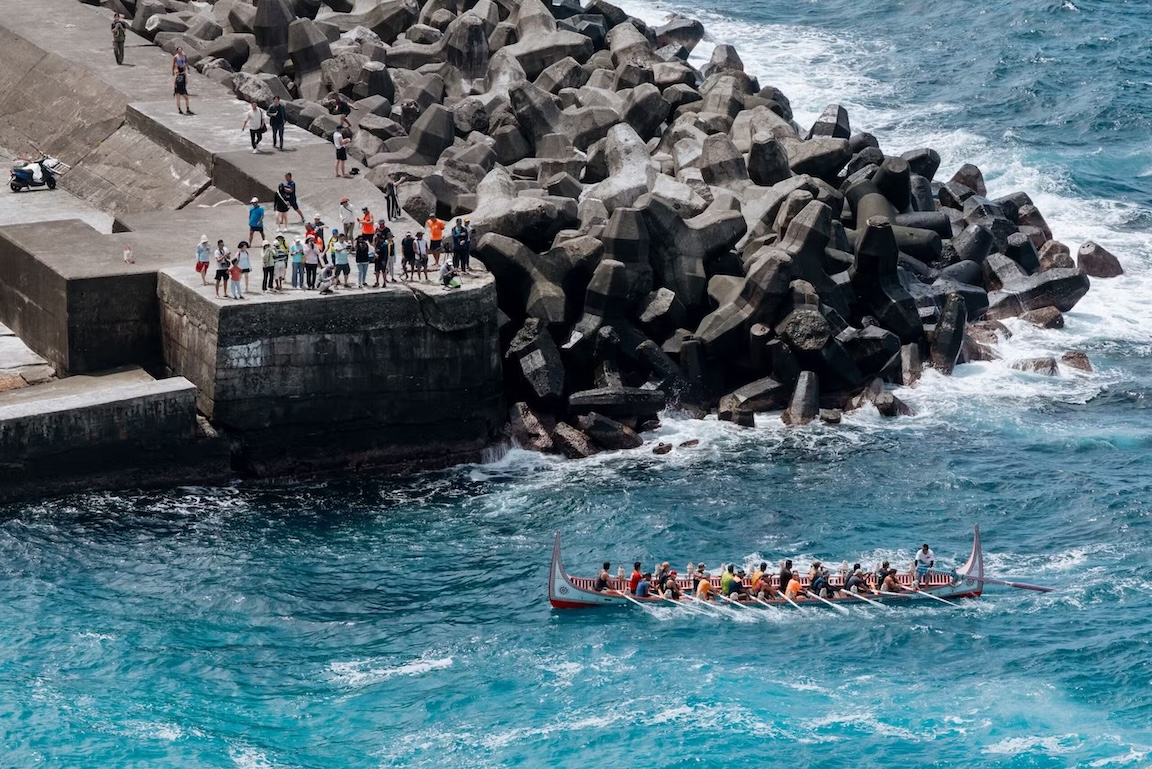
From the shores of Taiwan, twenty indigenous Tao men rowed their way to the Philippines on a hand-carved longboat.
The Tao are an Austronesian indigenous group in the outlying Orchid Islands of Taiwan. They are also considered one of the smaller indigenous groups, with a population of only around 5,000, making up less than 3% of the 23 million indigenous people in the country.
The Tao’s connection to Southeast Asia lies in the Bashi Channel trade route, which they often traversed in ancient times to trade with the Ivatans—an indigenous group of the Batanes and Babuyan Islands in the northernmost part of the Philippines. The traded items usually include anything from gold for smithing, cowhide to make armor, fish hooks for fishing, and produce.
While the two groups were friendly, according to a story from Orchid Island’s Iratay Village, the Ivatan women grew fond of the visiting Tao men, sparking jealousy and reducing occurences of trade to avoid conflict among them. A later trip would result in a fight, resulting in deaths on both sides and only two Tao men escaping back to their homeland. Since then, the Bashi Channel trade route has remained dormant, and contact ceased.
It wasn’t until 1982 that the groups reconnected, when anthropologist Dezso Benedek visited Orchid Island to compare its culture with Batanes. As he returned to Batanes, Benedek brought with him a Tao man named Si Mogaz, who married a local woman named Lita and brought her back to Orchid Island. Since then, exchanges between the Tao and Ivatan grew, culminating in a 1998 visit to Batanes by Tao people, cultural workers, government officials, scholars, and journalists to Batanes, where the then Orchid Island township chief and the Batanes governor affirmed their kinship and reestablished the historical Bashi route.
Ending its 300-year dormancy, the group of Tao men paddled their way through the dormant route on the vessel called Ovayan or “Golden Friendship.” Built by six communities on Orchid Island, the handcrafted canoe is the biggest the indigenous group has built, standing at a length of 12 meters or 39 feet. And after a test row on June 14, the voyage itself began the next day, taking 24 hours, with around 60 people taking turns to row in the 20-seat canoe—rotating in and out of support ships.
“With this project, we are re-establishing the sea route between Orchid Island and Batanes, allowing our cultures and languages to continue being passed on,” said Maraos, an Orchid Island Tao and the chairperson of Taiwan’s Indigenous Peoples Cultural Foundation, in an interview with Reuters.
Maraos also shared that he hopes this initiative will encourage more exchanges between other people and countries in the Pacific while also strengthening maritime culture. The gesture of friendship between the Tao and Ivatan will continue next year with the hope that Ivatan islanders would be able to row the Ovayan back to Orchid Island.