
“A war. A man. A trick — a trick to break the walls of Troy!” says the Bard. Lend me your ears, dear traveler; the King of Ithaca returns home!
Christopher Nolan’s The Odyssey has recently been the talk of the town for its distinct score, modern interpretation, and unique themes. The film chronicles the various trials of Odysseus, the King of Ithaca, as he journeys home after the conquest of Troy. As a fan of Greek mythology, this film had a beautifully unique way of portraying larger-than-life figures while keeping it grounded to truly focus on Odysseus’ perspective.
Read on for our High Five review of The Odyssey. Spoilers ahead, so be warned.
An Adaptation, Not a Recreation
First and foremost, we are reviewing the film as an adaptation, not a one-is-to–one recreation.The Greek poet Homer wrote the epic poem The Odyssey in the 8th Century BC, which Nolan had to condense into 2 hours and 52 minutes of cinema, so expect some changes.
Nolan’s Odyssey made sure the point of view stays entirely human, showing a more modern approach while tackling Greek mythos. The raging storm, the crack of thunder, and billowing wind are natural phenomena attributed to the gods, which did not manifest in a physical form as they would have in the original epic poem, but talked to ordinary people through natural elements, dreams, and illusions. And while mythical figures like Circe, Calypso, the sirens, the giants, the Cyclops, and Scylla and Charybdis all made appearances, they did so as natural elements of the story and not through fantastical means.
Gods or not, Nolan’s adaptation stays grounded to the themes in Homer’s original piece: the emotional and spiritual aspects of homecoming (nostos), loyalty, and self-discovery through choices, all the while removing certain elements that may have not gelled with a modern audience such as Odysseus’ pride and cunning wile, his familiarity with using lies and deceit, and his pragmatic view of the journey’s results.
A Star-Studded Cast
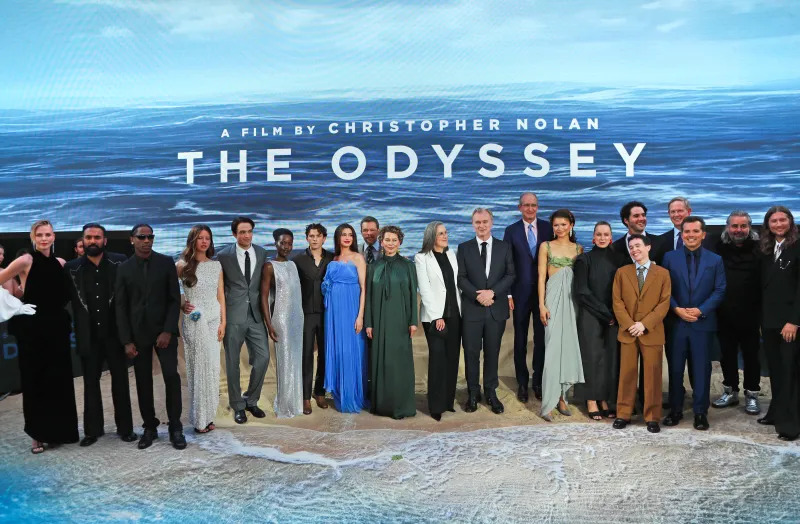
The cast and crew of The Odyssey | Photo from Universal Pictures
The press rounds for The Odyssey show just how stacked the cast is. Nolan works with frequent collaborators including Matt Damon as Odysseus, Anne Hathaway as Penelope, Robert Pattinson as Antinous, Benny Safdie as Agamemnon, King of Mycenae, and Elliot Page as Sinon.
First-timers on the Nolan train, but A-listers all the same, include Tom Holland as Telemachus, Zendaya as Athena, Lupita Nyong’o as Helen of Troy and Clytemnestra, Charlize Theron as Calypso, Jon Bernthal as Menelaus, John Leguizamo as Eumaeus, Samantha Morton as Circe, Mia Goth as Melantho, Himesh Patel as Eurylochus, and Travis Scott as the bard narrating Odysseus’ accomplishments.
All these actors brought together a well-rounded performance that gives space for the viewer to also feel the grief, love, and loss during the whole journey of Odysseus’ homecoming. Damon’s portrayal of Odysseus as a nuanced man gets special mention, especially during the travel through the siren-inhabited waters, as well as Pattinson as the likably unlikable Antinous, and Anne Hathaway as the steadfast and loyal Penelope.
Immersive Production with Visible Constraints
When the trailers of The Odyssey were released, the internet had all sorts of things to say about it, especially on the costume side; though it did not take away too much from the immersion, it just left an itch in our brain that we can’t resolve. Christopher Nolan defended the choices in an interview with Time, specifically about Agamemnon’s black armor with a matte finish and his “spine helmet,” saying, “You take bronze, you add more gold and silver to it, and then use sulfur. With Agamemnon, Ellen [Mirojnick], our costume designer, is trying to communicate how elevated he is relative to everyone else. You do that through materials that would be very expensive.”
Another controversial choice is the use of American English throughout the film. While most films set in ancient times or in fantastical settings usually use British English with more classical diction, the film used American English to help make the story feel more modern and in line with Nolan’s themes and approach. This may be a hit or miss with most viewers who are more accustomed to hearing British accents in classic adaptations.
A constraint that became more visible over time was how the editing relied on too many cuts. The Odyssey was famously filmed using IMAX cameras, which only has enough film for 3 minutes of shooting. This was not too obvious at first, but over time, the short sequences did not give audiences long enough pause to really take in the more emotionally impactful scenes, making the pace feel too fast at times despite the film’s long runtime.
The film’s soundtrack carried much of the weight of the film, with Academy-Award winning composer Ludwig Göransson outdoing himself by using historically accurate Bronze Age instruments such as the lyre, aulos–a wind instrument that means flute or double flute–and 35 bronze gongs of varying shapes. To double down on the immersive soundtrack are the thematically named songs such as “Ithaca” and “Let’s Go Home.” There’s a certain type of solemn grandeur when you listen to them as well because of the vocalization paired with the ancient sounds of Greek instruments.
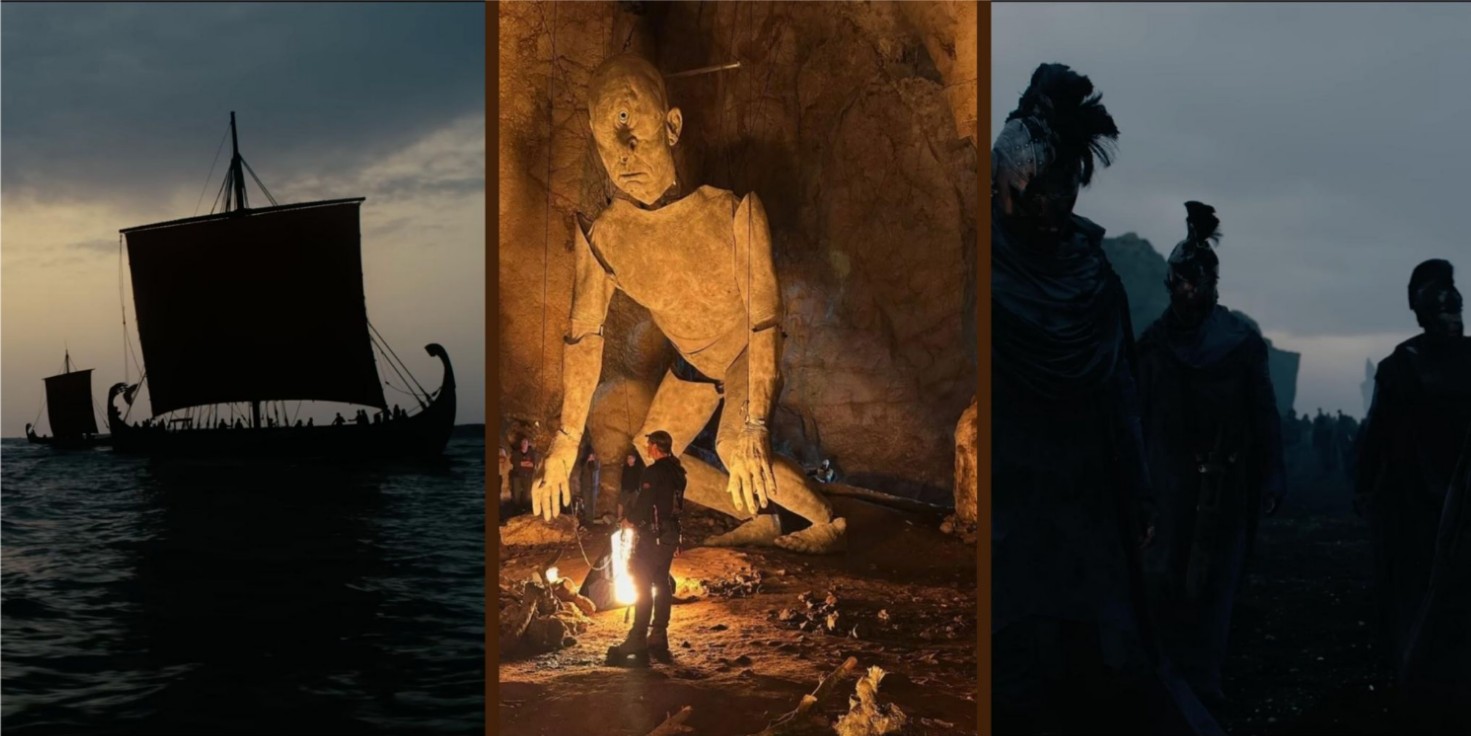
Set photos from Universal Pictures
Another plus for the production is the minimal reliance on Computer-Generated Imagery (CGI). Most of the effects were practical, as seen in the rendering of Poseidon’s son, Cyclops Polyphemus—a 60-foot puppet which was present on set. Another highlight was the rising of the dead when Odysseus visited Hades for advice on how to get home. The actors were buried in sand and simultaneously stood up for the shot. The Trojan Horse was also built for a life-size scale, making the scenes inside and outside seem more realistic. The production shows the love and effort put into getting this epic on screen.
Bare-Bones Storytelling Done Right
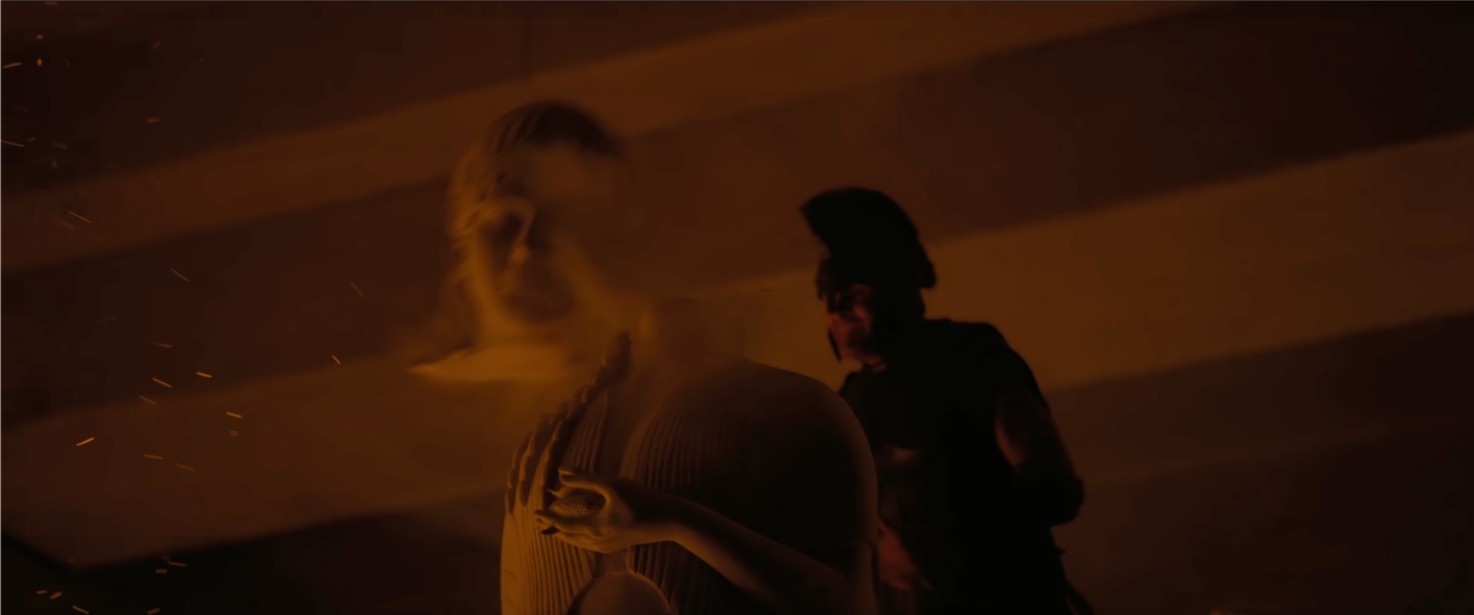
Still from Universal Pictures
The narrative is plain and simple: Odysseus does his best to get home despite gods, monsters, and men getting in his way. The film adds depth to the narrative by adding in non-linear glimpses into Odysseus’ past. “[Homer’s Odyssey] has a wonderful structure that I was able to be faithful to, and it’s a nonlinear structure,” shared Nolan in an interview with MS NOW.
Through Odysseus’ internal narration, we see blink-and-you’ll-miss-it moments in Troy, to the island right after their victory, and dialogue that pay homage to the epic poem while making the film entirely its own. One such quote that differentiates it from Homer’s Odyssey is “To burn the walls of Troy was to burn the world entire, including his home,” driving home the point that Nolan’s Odysseus does not glorify battle and conquest, unlike his classic counterpart.
A Snowball of Choices Leads to Rightful Consequences

Stills from Universal Pictures
After everything has been said and done, with regard to Troy, the journey of coming home for Odysseus has not been kind, but did offer some solace. The film may be set 3,000 years ago, but it tackles modern themes of how actions lead to outcomes and consequences, even with a divine being preceding our choices. Odysseus becomes a reminder for the viewers that while each and every one of us are on our own path to finding home, we have to live with the choices that we make.
SEA Wave Magazine gives Christopher Nolan’s The Odyssey a 3.5 out of 5 waves. What did you think of the film? Tell us your thoughts in the comments below!