
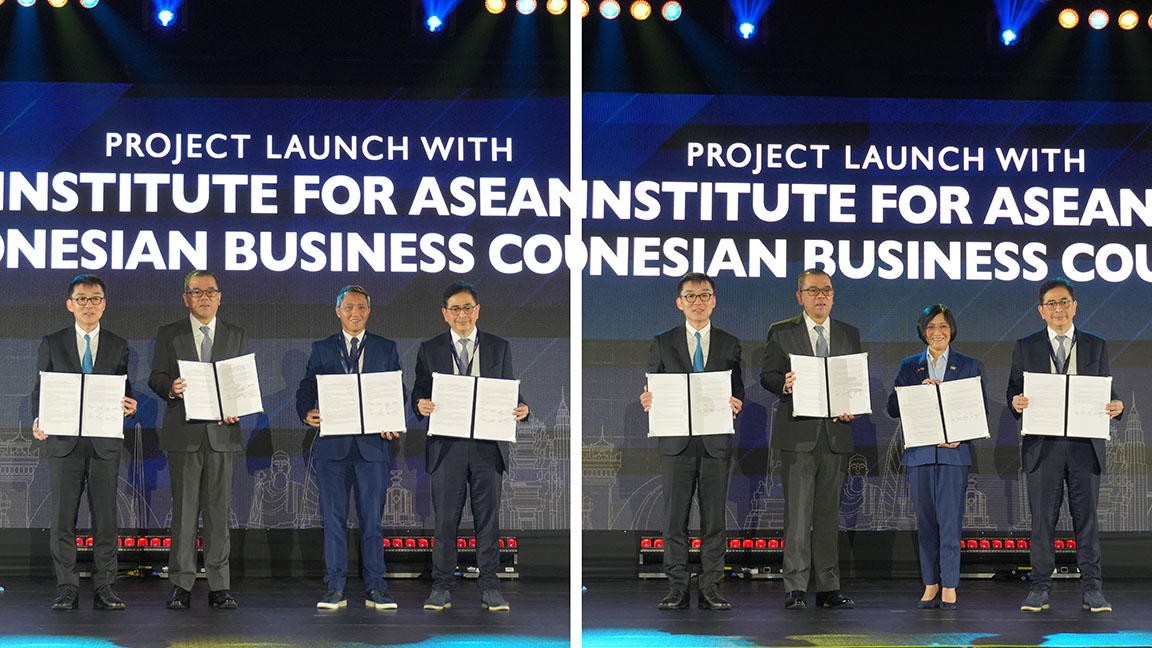
The Economic Research Institute for ASEAN and East Asia (ERIA) and the Indonesian Business Council (IBC) signed two letters of intent (LOIs) with energy companies to explore emergency oil access for the Philippines through existing storage facilities in Indonesia and Thailand. The proposed pilots were announced at the ASEAN Business and Investment Summit in Manila. The initiatives aim to contribute to strengthening energy security and enhancing resilience against potential oil supply disruptions in ASEAN, with ERIA and IBC signing both LOIs as knowledge partners to contribute research expertise and facilitate dialogue and information exchange amongst relevant stakeholders.
Overview of the Proposed Pilot Projects
The proposed pilot projects—PNOC Exploration Corporation (PNOC-EC) and PT Interport Mandiri Utama (Philippines–Indonesia), and PNOC-EC and The Shell Company of Thailand Limited (Philippines–Thailand)—focus on exploring possible areas of co-operation related to oil ticketing mechanisms, including the potential use of existing oil storage facilities in Indonesia and Thailand to support oil supply security and emergency preparedness in the Philippines.
Under an oil ticketing arrangement, a participating entity pays for the right to access oil held in another country’s storage facilities in an emergency, subject to agreed conditions. This approach could reduce the need for governments to build new storage facilities and purchase additional oil
stocks upfront.
Strengthening ASEAN’s Oil Security
ASEAN faces increasing exposure to oil supply disruptions amid geopolitical uncertainties and growing dependence on imported oil. Southeast Asia’s crude oil import dependence reached about 66% in 2024. The Philippines imports 99% of its crude oil, while Thailand imports 94%. Several ASEAN countries also rely heavily on oil supplies from the Middle East. Most ASEAN Member States have relatively limited emergency oil stocks, highlighting the need for stronger preparedness and regional co-operation.
From Study to Practical Co-operation
Amid growing concerns over energy security arising from the situation in the Middle East, Philippine President Ferdinand R. Marcos Jr. called for a regional study on joint oil stockpiling, building on ERIA’s work, and political support to move towards implementation.
ERIA’s study on ASEAN Oil Stockpiling Strategy 1 develops and assesses alternative stockpiling scenarios, examining the benefits and challenges of combining national reserves, ticketing arrangements, and joint stockpiling. It also proposes a phased implementation roadmap.
The study also examined the cost of holding an additional 60 days of oil reserves across ASEAN. It found that increasing the share held as joint stocks from 10 to 30 days, while keeping the same total volume and the same 5 days of ticketed stocks, could lower annual stockholding costs from US$2.80 billion to US$2.19 billion. That represents an estimated saving of US$610 million a year, or about 22%, under the more co-operative regional scenario.
In parallel with ERIA’s study, ERIA and IBC have facilitated dialogue amongst relevant stakeholders to explore potential pilot projects. As part of these efforts, they convened a high-level business roundtable in Singapore, bringing together leading energy companies and other stakeholders.
The signing of the two LOIs marks a step towards translating ERIA’s study findings into practical regional co-operation. The initiative was highlighted during the Energy Session of the ASEAN Business and Investment Summit (ABIS) 2026 in Manila.