

The Department of Foreign Affairs (DFA), National Historical Commission of the Philippines (NHCP), and other Philippine officials have rejected claims made by a group of Chinese scholars asserting that the Philippines’ northernmost province of Batanes belongs to China through Taiwan.
During a symposium held on June 30 at Jinan University in Guangzhou, China, the participants argued that the Batan Islands are a natural geographical extension of Taiwan and claimed that the Philippines has no historical or legal basis for administering the province.
Ju Hailong, dean of Jinan University’s School of International Studies, claimed that Batanes was historically administered as part of Taiwan during the Ming and Qing dynasties. This was because the Ivatan people share close linguistic and cultural ties with Taiwan’s Indigenous Tao people of Orchid Island. The two communities were once active in maritime trade, exchanging goods across the Bashi Channel before the Spanish imposed strict border controls. Their languages also shared significant similarities, reflecting their shared Austronesian heritage.
Participants concluded that the Philippines’ administration of Batanes lacks historical and legal basis, however, the Chinese government has not formally adopted or endorsed the symposium’s conclusions.
In a text message sent to reporters, DFA spokesperson Analyn Ratonel dismissed the assertions, saying the Philippines will not entertain revisionist claims over its territory and urged the scholars to focus on “genuine, good-faith studies of the region.” She also noted that the Chinese Consulate General in Laoag includes Batanes within its Philippine-approved consular district.
The National Historical Commission of the Philippines (NHCP) also released an official statement rejecting the assertions, saying they have no basis in historical research. The commission cited archaeological, historical, and geographic evidence showing that Batanes has long been part of the Philippine archipelago and emphasized that there is no record of Chinese governance over the islands. One of the geographic data points out that Batanes is connected to the northern Philippine landmass.
According to the NHCP, the Spanish colonial government formally incorporated Batanes into the Province of Cagayan in 1783, and Philippine governments have exercised continuous sovereignty over the islands ever since. The commission also noted that the Ivatans actively participated in the country’s struggle against Spanish and Japanese occupation and that Batanes was also represented in the Malolos Congress in 1898, reinforcing Batanes’ long-standing place in Philippine history.
Batanes Rep. Ciriaco Gato Jr. also made a statement last Friday, July 10, condemning the claims and calling them “an affront” to the identity of the Ivatan people.
“Batanes is a province of the Philippines. The Ivatans are Filipinos. These are enduring truths established by history, affirmed by our Constitution and laws, and embodied in the identity and collective experience of our people”, Gato said.
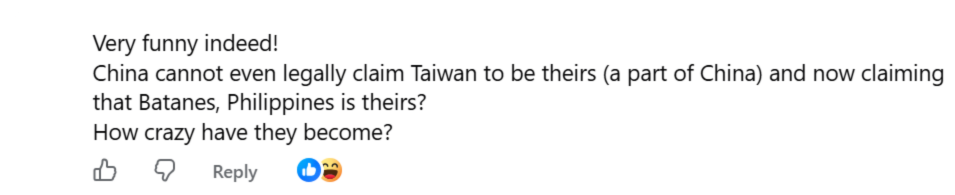
This issue also sparked various reactions from netizens, with some expressing anger and disbelief over the claims made by the Chinese scholars. Netizens responded by swarming the comments section of social media posts announcing the news, explaining the province’s history and indigenous heritage, and showing their outrage towards the claim.


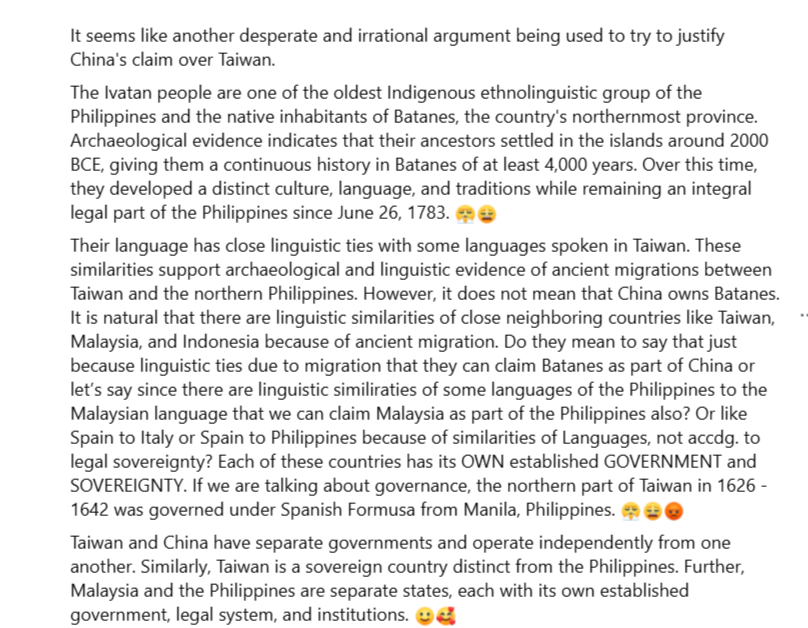
Another netizen responded to Hailong’s claim regarding the linguistic connection between the Tao and Ivatan people, saying that similarities in language and culture resulting from historical migration should not be used as the basis for territorial claims.
The Chinese scholars’ claims also surfaced just days before the Philippines marked the 10th anniversary of the 2016 arbitral ruling that dismissed China’s nine-dash line claims in the South China Sea.
As debates over territorial claims continue, we, as Filipinos, should remain informed, vigilant, and brave in defending the country’s sovereignty and territorial rights. If we fail to stand up and defend what is rightfully ours, then we risk allowing other countries to take control and have greater influence over our own affairs. In the long run, we may lose what has always belonged to the Filipinos in the first place.
Defend our land and defend what’s ours. 🇵🇭