
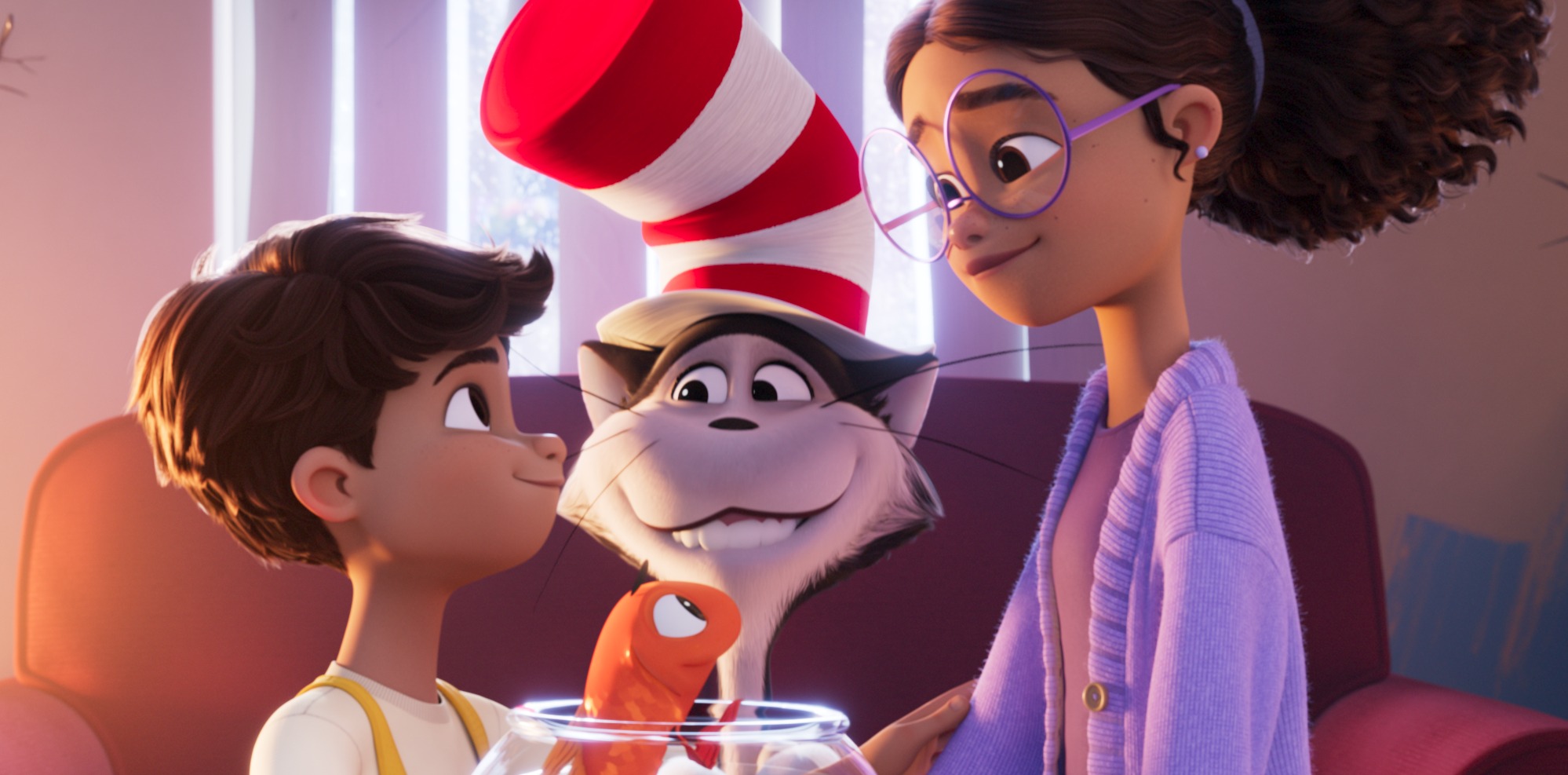
For “The Cat in the Hat” production designer Aidan Sugano, it was really important that the creative team behind the movie did the beloved story by Dr. Seuss justice.
“This book has defined so many childhoods and been adored across so many generations,” shares Sugano. “Since there have been so many amazing interpretations of Seuss properties, we knew we wanted to find our own version. There were some simple things we knew we had to preserve – like the specific red of the Cat’s hat and bow tie, the iconic hair and costumes of the Things and base shape language of the world and some of the characters. But the most important thing we had to preserve was the spirit of the source material. We needed to find and distill that spirit so no matter how expansive our world became, we always stayed true to the heart of what made the Cat in the Hat great.”
Art director Amos Sussigan agrees. “We aimed to honor the spirit of the original books while balancing multiple visual styles,” he says. “Seuss isn’t just about the stories. It’s in his linework, his compositional style, his use of color, it’s the spirit we all connect to. The Seuss we all remember. So, to reflect that theme while staying true to the source material, we stripped it down to its simplest form.
“We set the rules for design based on those iconic memories: bold, graphic, and minimal. We chose a rendering style that would embrace the limitations of that approach, where we could play with the ‘lost and found’ quality of the illustrations. The palette was bold, minimalist, but also expressive. It leaned into that whimsical, irreverent surrealism that Seuss captured so well. And we paired that with dynamic camera angles and the use of negative space, all of it meant to reinforce the story, not distract from it.”
For Ryan Gaffney (head of story), Matt Waters (visual effects supervisor) and Jean-François Leroux (digital effects supervisor), the quirky energy and whimsy of Dr. Seuss’s works were a must-have in the film. “Those simple drawings by Dr. Seuss were a huge inspiration,” says Gaffney. “We did our best to honor that quirky, energetic and charming version of the Cat in the Hat. Each story by Seuss has an amazing little emotional punch at the end – the directors [Alessandro Carloni and Erica Rivinoja] really wanted to maintain that feeling with the movie.”
Waters says that the whimsical and surrealistic world-building of Dr. Seuss informed the design of the worlds they built and the way that shots were composed. And the playful, irrational and over-engineered style of the books informed the character performances and asset designs. “The illustrations themselves are very interesting in their use of color and composition,” says Waters. “There’s a very limited color palette, large areas of negative space and compositions that often put things off-center. We tried to bring some of those ideas into the film, particularly in the more Seussian areas of the world. We wanted to find something that felt very graphic and handcrafted but was unique to this movie.”
Leroux did not grow up with “The Cat in Hat,” but recognizes the universal love for Dr. Seuss. “Dr. Seuss wasn’t only an incredible storyteller; he was also an amazing artist. His use of line work, flat color, unusual shapes and imaginative environments created a visual language that is instantly recognizable,” he says. “Hopefully, audiences who know and love the books will recognize those iconic elements and feel that sense of nostalgia.”
Bill Hader, who voices the Cat in the Hat, loved the movie’s animation as soon as he saw some storyboards. “When they sat me down and showed me basically the opening of the movie and story reel in animated storyboards, I immediately was taken with it,” shares Hader. “They captured what I liked about the book, but it had its own irreverent humor. I like that aspect of it. And in playing the Cat, they wanted me to expand on that. He’s a complicated and imperfect guy, uh, cat.”
“The Cat in the Hat,” starring Bill Hader as the voice of the Cat, America Ferrera, Xochitl Gomez, Tiago Martinez, Matt Berry, Bowen Yang and Giancarlo Esposito, is now showing in cinemas.